via Buffer
Saturday, January 5, 2013

Friday, January 4, 2013
Central Bank Balance Sheets, Inflation and Farmland as a Hedge
 |
| As per Agora Financial - central bank balance sheets are exploding due to QE, and hence the interest in assets like farmland which can serve as an inflation hedge |
As we have always said previously about investing in farmland, it is a real asset that cannot be printed or conjured out of thin air by central banks. Farmland also pays current income, and is a fine method of riding the worldwide trend of rising population and shrinking arable land.
Feel free to explore further the possibility for making farmland part of a portfolio of real assets: http://www.greenworldbvi.com/alternative-investments-options/agricultural-farmland/
Monday, November 5, 2012
Fiat Currency Allows Governments to Print Unlimited Amounts of New Money
| The fiat currency printing press continues to roll out more money through QE |
So, with all of that new fiat currency created through QE, why have we not seen sky high inflation yet? The reason we have not seen high inflation is that people and businesses are still squirreling away Pounds, Euros and dollars because they remain anxious worried about the prospects for the economy.
Sooner or later, however, the Federal Reserve and other western central banks will have created so much new paper fiat currency through QE that at that point, the urge to buy – whether it's capital goods or consumer goods or commodities – will revive the economy, and the recession will come to an end. That will reduce the level of caution people feel to something near normal. The result will be that all of the excess money that has been created since 2008 will come pouring out. For a little while it will look like everything is going well – the economy will seem to be booming, we can all go back to our old ways. But then the extra printed money will set off massive inflation, and then the good times will be over. When that day comes, make sure you have some amount of real asset investments such as forestry or farmland in your portfolio as a hedge.
Contact us at info@greenworldbvi.com t learn how we can protect you from the dangers of QE and the ravages of inflation.
Wednesday, October 17, 2012
QE Craziness is Out of Control - Buy Real Assets That Cannot be Printed
 |
| Mervyn King cranks up the BoE's money printing machine |
Of the £100 billion in deficit financing raised by the UK Treasury this year, approximately £62 billion has been purchased by the BoE. To note an even more incredible figure, the BoE has purchased £42 billion of the £34 billion raised by the government since August 1st. Think about it - the BoE is literally financing the British Government! And this is QE in extremis (to coin a phrase our favorite journalist Ambrose Evans-Pritchard might use), with the BoE not just buying existing bonds or other assets; rather, the BoE is literally creating new money with the push of a button!
In the face of this message, how can a retail investor hedge against inflation?? The answer is very simple. Buy something the government cannot print any more of, such as timber investments or agriculture investments. Legendary commodities investor Jim Rogers is a huge fan of agriculture, and the always prescient Jeremy Grantham also just recommended both institutional and retail investors have long-term investment in farmland and forestry in their portfolios.
Too see how GreenWorld can assist you in hedging against QE, please contact us at info@greenworldbvi.com.
Friday, September 7, 2012
Forestry Investments Make an Excellent Hedge Against Inflation
 |
| Forestry - an excellent investment and inflation hedge |
One option very much worth considering is GreenWorld's European forestry investment. This forestry investment is located in Germany, and involves a hardwood tree called Paulownia. There are two reasons to consider this forestry investment:
1) First, the fantastic long-term returns associated with hardwood timber investments as compared to softwood timber investments such as pine. A m3 of softwood pine lumber for example goes for € 60- € 80/m3 or $86 - $115/m3 . Paulownia, by contrast, for about € 400- € 500 or $575 - $720/m3.
2) Second, not only are there fantastic long-term returns associated with Paulownia timber, but the fact that the entire project and forestry plantation are situated in the highly stable country of Germany makes this an extraordinarily attractive project in which to invest. The stability and rule of law that Germany possesses is unparalleled.
Please contact us at info@greenworldbvi.com to learn more.
Monday, July 30, 2012
Jim Rogers on Quantitative Easing and Farmland Investment
 |
| Jim Rogers on printing money |
What does Rogers like now? Jim Rogers loves farmland, and in fact manages two farmland funds himself. Rogers argues that farmland investments are an excellent way to play continued high agricultural commodity prices, and farmland is also an excellent hedge against inflation. And, in a near-zero interest rate world, farmland investments generally pay excellent yearly dividends as well. For those interested to use farmland investments as a way to hedge against inflation, there are now a number of unique projects have opened up globally for retail investors in farmland. GreenWorld offers three farmland investments for retail investors:
Farmland investment in AfricaPlease contact us at info@greenworldbvi.com for additional information in how you can participate in these projects.
Farmland investment in Europe
Farmland investment in Australia
Wednesday, July 18, 2012
Hyperinflation Caused by QE and Massive Debt Could Happen - UBS
 |
| Hedge against QE and inflation with real assets |
"Hyperinflation: Paper money only has a value because of the confidence that the money can be exchanged for a certain quantity of goods or services in the future. If this confidence is eroded, hyperinflation becomes a threat. If holders of cash start to question the future purchasing power of the currency and switch into real assets, asset prices start to rise and the purchasing power of money starts to fall. Other cash holders may realize the falling purchasing power of their money and join the exit from paper into real assets. When this self-reinforcing cycle turns into a panic, we have hyperinflation. The classic examples of hyperinflation are Germany in the 1920s, Hungary after the Second World War, and Zimbabwe, where hyperinflation ended in 2009. Indeed, hyperinflation is not that rare at all. Economist Peter Bernholz has identified no fewer than 28 cases of hyperinflation in the 20th century."
While we at GreenWorld still believe that hyperinflation is a very low probability event, it is certainly what might be called a "fat tail" type of risk that is worth hedging against. There is no question that it is worth asking how we can protect ourselves from QE and the money machines of central bankers. We remain firm in our belief that real asset investments are the ideal way to hedge against QE and the risk (however small) of hyperinflation. Lately, we have seen a great deal of interest from investors in our agriculture investments, and we encourage investors to take a look at our offerings in European farmland, African farmland and Australian farmland.
Friday, June 29, 2012
How to Protect Yourself from QE?
| Hedge against inflation and QE |
How can you protect yourself and your family from QE? The best way to do this is to invest in real assets. Real assets will both hold their value well during inflation, and if you select the right type of real assets you can also realize both substantial income as well as excellent potential for capital gains. Here at GreenWorld, two of our favorite real assets are farmland and bamboo. Both farmland and bamboo pay substantial dividends, and both reflect growing markets. The market for bamboo is projected to double within the next five years, whilst the continued rise of food prices will make arable farmland increasingly valuable.
If you want to consider investing a small portion of your savings in real assets, please visit our website to learn more about farmland investments and bamboo investments.
Thursday, June 7, 2012
Fear of Inflation Rises Hedge with Real Asset Like Forestry Investments
 |
| European Forestry Investment in Germany to Hedge Against Inflation |
The Germany magazine Spiegel recently published article about the Germans fear of rising inflation. There is a longtime worry about inflation in Germany that is deep in that country's psyche due to the experience with hyperinflation in Weimar Germany.
Luckily for Germans - as well as anyone worried about inflation - an excellent option to hedge against inflation is available right in Germany. GreenWorld is pleased to offer forestry investments in Paulownia hardwood trees as part of a plantation located right outside Berlin.
Hardwood timber sells at a significant premium to softwood timber, and provides steady returns in the range of 10-12% per annum over many years. Timber and forestry investments also are completely uncorrelated to the performance of stocks and bonds, as the investment returns are determined by the price of the wood and the growth of the trees. In addition, the fact that the entire project and forestry plantation are situated in the highly stable country of Germany makes this an extraordinarily attractive project in which to invest.
If you are interested in GreenWorld's European Forestry Investment, please feel free to contact us at info@greenworldbvi.com or ring us on +44-20-3286-2975
Monday, May 14, 2012
Why Invest in Farmland? As an Inflation Hedge Against the Massive Debt Overhang in the UK and elsewhere
Agricultural investments in land will provide investors an hedge against inflation as a "hard asset", whilst also providing a steady stream of good dividend income and offering excellent upside potential for capital gains due to the ongoing agricultural "super cycle" as coined by noted farmland and commodities investor Jim Rogers.
 |
| Massive Debt Overhang in Global Economy Ensures Addition QE and Printing of Money |
Thursday, May 10, 2012
Goldman Sachs and Bond King Bill Gross: QE3 is on the Way in the United States
 |
| Printed Money and Quantitative Easing |
As the graph demonstrates, there has been a huge move vertically in the size of the US monetary base since the financial crisis began, all from newly created money by the US Central Bank the Federal Reserve. However, lest those opposed to QE criticize the Americans too harshly, it is well worth noting, as we did in an earlier post, that both the ECB and the PBoC (the Central Bank of China) both have larger monetary bases then the American FED. For those who may have been contemplating the notion of investing in real assets, the latest news from the markets is yet one more reason to look at this option to hedge against inflation.
Friday, May 4, 2012
Will the ECB Turn to Quantitative Easing to Rescue the Eurozone Europe?
If you look at the graph below, unemployment in Spain and Greece is at or above 20pc, and its nearly 14pc in Portugal and Ireland. It seems inevitable that the ECB will need to embark on a massive QE program to save the PIIGS economies, most likely by printing money to buy the sovereign debt of these countries to keep the interest rates on that debt down. Whatever the short term affect of this action, it still seems that at some point in the future this newly printed will leak into the real economy. Hence, it makes sense to look closely at real asset investments now just as a hedge against future inflation. The numbers below are tragic, and are more evidence of the madness behind the idea of a single currency for 17 separate and disparate nations.

Wednesday, April 25, 2012
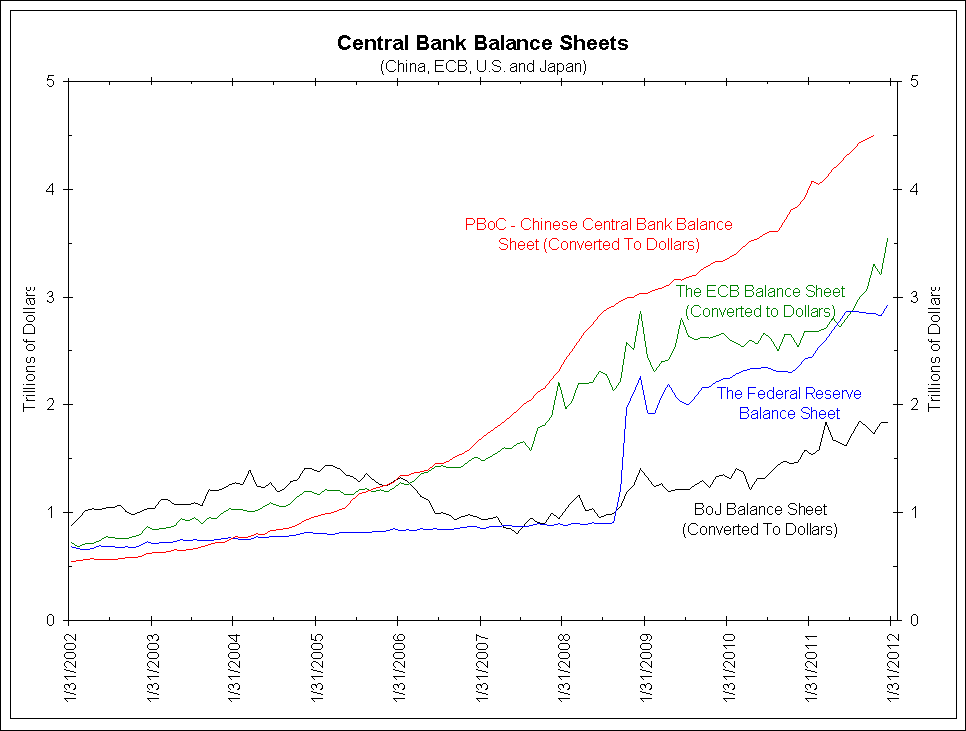
QE and the Balance Sheets of the World's Central Banks
 |
| The effects of quantitative easing by the central bank of China |
When talking about QE (Quantitative Easing), it is easy to lose site of just how big some of the numbers are. We are, therefore, going to do a series of posts briefly showing some of the hugely engorged balance sheets of some of the world's major central banks as a result of QE.
First, a quiz: Can you guess which central bank has the largest balance sheet in the world? Whilst many might guess that its the United States Federal Reserve due to how closely the FED is watched (and frequently criticized) by analysts and world leaders, but the Fed's balance sheet - at approximately US$2.8 trillion - is not even close to being number one. As you can see from the graph, the central bank of China - the PoBC - is far and away the highest at approximately US$4.5 trillion. Its no wonder that inflation has consistently remained high in China, and that the Chinese leadership is concerned about inflation's effect on the Chinese Middle class. As we have said before, if you are worried about the inflationary effects of QE, the best strategy is to hedge with real assets such as farmland investments and forestry investment.
Tuesday, April 17, 2012
The Con of Inflation
Why do we call inflation a con? Its very simple really - inflation robs workers. It’s essentially a hidden tax. If you look at the last two to three decades, it seems like workers wages have gone up nicely. They must be much wealthier, right. But, if you measure workers wages based on their actual purchasing power, i.e. adjusted for inflation, workers incomes have remained stagnant. Indeed, since the financial crisis began, workers real incomes have gone down.
 |
| High Inflation is a Tax on Workers |
Let's the UK as just one example. The latest inflation figures out of the UK show inflation at 3.5pc. Indeed, inflation has remained at 3pc or higher for 28 straight months. That means over this 28 month time period, inflation compounded has gone up a total of 8-10pc in total. Meanwhile, actual salaries and incomes are flat or lower. What does this mean? It means that UK workers' real incomes - i.e. what their salaries actually allow them to buy - are lower by this same 8-10pc figure. Is it any wonder than that real wages in the UK are back to the levels of 1997? Talk about a lost decade. And the UK is not alone unfortunately, the same basic calculation applies to the United States and other western countries. Finally, due to budgetary pressures, we can expect taxes to go in only one direction - up.
Taking all of this into account, its no surprise that most people feel poorer and hard-pressed. Whilst the rich may move to tax havens such as Dubai or Monaco, the average individual can still consider the option of protecting their financial future with real asset investments. This blog will show you a number of options for doing so.
Subscribe to:
Posts (Atom)